


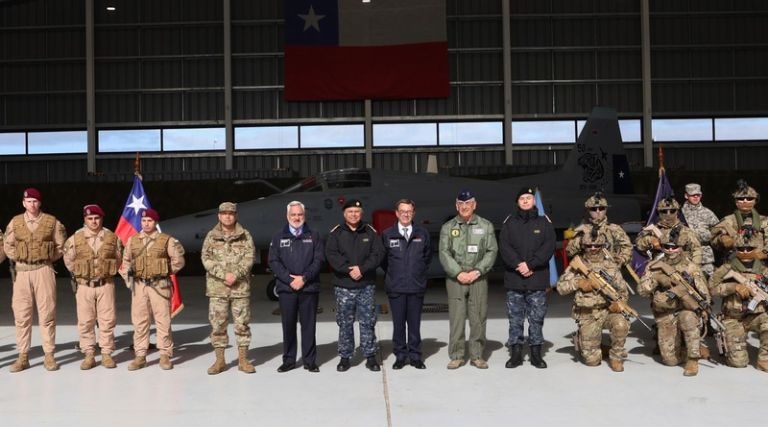

On the shores of the Strait of Magellan and flanked by the high command of the Armed Forces, Minister Fernando Barros announced a plan for military acquisitions and infrastructure projects that will double the spending levels of the previous period, while ruling out any budget cuts for the ministry. The announcement focused primarily on the far-southern theater of operations, where sovereignty depends directly on controlling maritime routes and maintaining the ability to operate continuously toward Antarctic territory. As the minister noted, “resources allocated to defense translate into concrete projects that fit into high-level defense planning”—a process currently defining the ten-year directive that will guide the country’s military procurement.
For the Navy, the key announcement concerns the renewal of its open-water aerial reconnaissance capabilities. The minister confirmed that next year, “the necessary capabilities to strengthen surveillance of our maritime zones will be added through the renewal of the Navy’s long-range surveillance aircraft”. This measure aims to maintain continuous patrolling of channels and inter-oceanic passages, enhancing oversight regarding foreign fishing fleets and organized crime along southern routes. In Barros’s view, “decisions regarding a fighter jet, a ship, a ground-based system, or strategic technological infrastructure are not made overnight. They require study, evaluation, funding, acquisition, personnel training, and the operational integration of the new capability. These are processes that can span several years and, in many cases, extend beyond the term of a single administration”.
On land, naval operations will be supported by civil infrastructure projects in the regional capital. The minister confirmed that the government is securing funds to optimize berthing and supply support for vessels, stating that “maritime logistics capabilities are essential for the southern and Antarctic regions. That is why the Ministry is arranging funding to upgrade naval port infrastructure in Punta Arenas—a project that strengthens our Navy’s operational reach and benefits the area’s entire maritime sector”. In this vein, Barros maintained that these operations are crucial “for the State’s permanent presence in the Strait of Magellan and southern waters, and for consolidating Punta Arenas as the primary gateway to the Antarctic continent.”
The program presented in Magallanes also incorporates the needs of the other two branches of the armed forces. Regarding the Air Force, Minister Barros stated that studies would be launched to replace the F-5 fighter jets—after half a century of service—and to select the aircraft that will succeed the veteran Bell UH-1H helicopters. Plans are also in place to upgrade the C-130 Hercules fleet that maintains the logistics chain with polar bases. Meanwhile, for the Army, the fire-control systems of the Leopard 1 tanks deployed in the far south will be updated, and the installation of permanent bases with stable troop complements is being evaluated. All of this aligns with a shared principle that Barros summarized for the military leadership: “Defense is not improvised; it is planned, prepared, and built with a long-term State vision”.
 Related News
 Tourism industry prepares to receive large number of tourists for Expo Naval
 Exponaval confirms its success and reaches 75% of its spaces sold out
 MetOcean Telematics will exhibit technological systems for training of naval forces at ExpoNaval